Website Design Uganda

+256787568587

The Ultimate Guide to Machinery Procurement and Equipment Hire: Commercial FAQs Across Six Industrial Sectors

Managing an equipment fleet is one of the most capital-intensive aspects of modern civil engineering, commercial agriculture, infrastructure development, and industrial power distribution. For project managers, procurement officers, and site engineers, choosing whether to purchase equipment outright or source it through commercial hire requires a deep understanding of machine kinematics, logistics, and financial realities.

This guide answers the most critical frequently asked questions about machine capabilities, selection criteria, and rental considerations across six core industrial sectors.

Pillar 1: Earthmoving and Digging Equipment Hire

What operational variables determine whether a project should hire an Excavator, a Mini Excavator, or a Backhoe Loader?

The choice depends on work volume, spatial constraints, and required mobility:

  • Excavators (13 to 50+ Tons): These heavy tracked machines are essential for bulk earthmoving, deep trenching, and heavy utility installations. Their 360-degree continuous structural rotation allows them to dig and dump quickly without moving the tracks, maximizing production rates.
  • Mini Excavators (1 to 8 Tons): These compact machines feature rubber tracks and variable-width undercarriages, with many designed for zero-tail-swing. They are ideal for tight residential jobs, interior demolition, and urban utility work where a full-sized machine would damage pavements or run into structural walls.
  • Backhoe Loaders: A highly versatile option built on a mobile wheeled tractor chassis. They feature a front-mounted loader bucket and a rear-mounted digging boom restricted to a 180-degree swing arc. Because they can drive between job sites on public roads at speeds up to 40 km/h, they eliminate the mobilization and transport costs associated with tracked equipment. This makes them highly economical for scattered municipal maintenance work and short-term utility installations.

How do undercarriage dynamics and surface ground pressure dictate the rental choice between Skid Steer Loaders and Compact Track Loaders (CTL)?

Operating conditions determine whether wheels or tracks are more appropriate:

  • Skid Steer Loaders: Use four high-performance rubber tires driven by independent hydrostatic motors. They turn using differential steering, causing the tires to skid across the ground. This action concentrates point-load pressures (40 to 50 PSI), which can rut soft dirt but delivers excellent speed and agility on hard, abrasive surfaces like asphalt, concrete yards, and bedrock.
  • Compact Track Loaders (CTL): Use a continuous rubber track system that distributes the machine’s operating weight across a much larger surface area, lowering ground pressure to just 3.0 to 5.5 PSI. This high flotation prevents the machine from sinking into soft mud, wet clay, or loose sand, allowing projects to maintain momentum through heavy rainy seasons.

When should a fleet supervisor hire a Crawler Loader instead of a conventional Front End Loader or Payloader?

  • Front End Loaders / Payloaders: Built on a rubber-tired, articulated chassis that steers via central hydraulic pivot cylinders. They excel at high-speed load-and-carry operations on firm, level ground, such as moving aggregate piles or charging asphalt batch plants.
  • Crawler Loaders: Combine the lifting arms and Z-bar bucket linkage of a loader with the rugged steel track undercarriage of a bulldozer. They are the ideal choice for demanding environments like demolition sites, scrap metal yards, and sharp rock quarries, where rubber tires face a high risk of punctures or slices. The track design also provides superior traction and stability on steep slopes and uneven terrain.

What are the deployment criteria and mechanical differences between Dragline Excavators and High-Reach Demolition Excavators?

  • Dragline Excavators: Large crane-like structures that use a system of steel cables and drag chains to cast a heavy digging bucket out over a work area and pull it back toward the machine. They excel at bulk excavation below track grade in large open-pit mining operations, deep canal dredging, and major harbor expansions.
  • High-Reach Demolition Excavators: Modified hydraulic excavators equipped with multi-piece structural booms that can extend specialized attachments—like hydraulic concrete pulverizers, demolition shears, and processing grapples—several stories into the air. They are engineered with wide track bases, heavy counterweights, and automated tilt-sensing warning systems to safely dismantle high-rise structures from the top down.

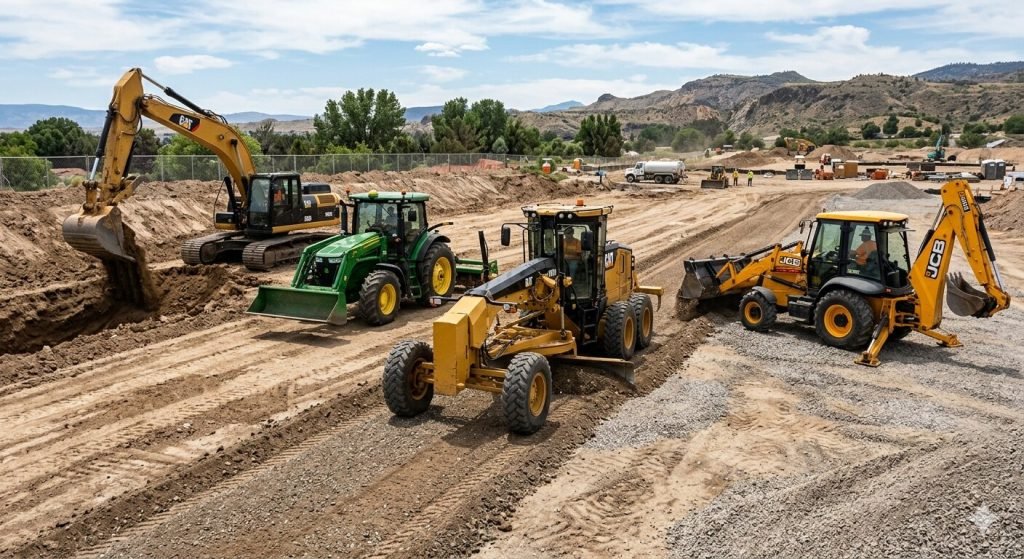
How do Motor Graders, Bulldozers, and Wheel Tractor-Scrapers work together to execute large-scale earthmoving profiles?

On major infrastructure projects like highway construction or airport grading, these three machines operate as an integrated production system:

  1. Bulldozers: Use their high tractive force and heavy steel blades to clear trees, cut through tough virgin soil, and push bulk materials to establish rough site elevations.
  2. Wheel Tractor-Scrapers: Act as high-speed, self-loading haulers for long-distance earthmoving. The machine lowers its belly-mounted cutting edge to shave off a uniform layer of soil, collecting it into an internal bowl. It then carries the material at road speeds to the fill zone and uses an internal ejector plate to spread it in a controlled, even lift.
  3. Motor Graders: Follow behind the scrapers and dozers to perform the final precision leveling. Their long, highly adjustable mid-mounted moldboard blade can be tilted, angled, and shifted horizontally to smooth out the base materials, carve drainage ditches, and establish precise subgrade elevations accurate to within fractions of an inch.

What structural factors separate Articulated Dump Trucks (ADTs) from Rigid Frame Dump Trucks for heavy site hauling?

  • Articulated Dump Trucks (ADTs): Feature a permanent two-part chassis joined by an oscillating, rotating hitch. This allows the front cab and rear dump bed to twist independently, keeping all six wheels in contact with the ground over deep ruts, thick mud, and steep grades. They are the standard rental choice for early-stage earthmoving on unprepared sites, with payloads typically capped between 25 and 55 tons.
  • Rigid Frame Dump Trucks: Built on a single, ultra-stiff continuous steel chassis. They require well-maintained, smooth haul roads to prevent structural frame fatigue. However, they offer massive payload capacities ranging from 60 to over 400 tons, making them the most cost-effective haulage solution for high-volume rock quarries and deep open-pit mines.

Pillar 2: Drilling and Auger Equipment Procurement

How do mechanical torque capacity and depth constraints vary across hand-operated Earth Augers and machine-mounted post hole diggers?

  • One-Man Augers: Powered by small 2-stroke or 4-stroke gasoline engines (under 50cc). They are mechanically limited to narrow bit diameters (2 to 8 inches) and maximum depths of about 3 feet, making them suitable for residential fencing and landscaping.
  • Two-Man Augers: Feature larger engines (50cc to 70cc) and wider handlebar assemblies that allow two operators to safely counter the machine’s torque forces. They can drive bits up to 12 inches in diameter down to 4 feet.
  • Hydraulic Post Hole Diggers: Machine-mounted attachments powered directly by the high-flow auxiliary hydraulic circuits of skid steers, tractors, or excavators. These systems eliminate manual labor and leverage the host machine’s weight to apply constant downward force. They can deliver thousands of foot-pounds of torque to drive auger bits up to 36 inches in diameter through dense clay, rocky soils, and deep root systems down to depths of 10 to 15 feet.

What geological parameters require a project to hire a Rotary Drilling Rig versus a Percussion Drilling Rig?

  • Rotary Drilling Rigs: Use high downward axial pressure (pulldown weight) combined with continuous, high-torque rotation to grind through subsurface rock formations using tri-cone roller or diamond-impregnated bits. High-pressure drilling mud or water is continuously pumped down through the hollow drill string to cool the bit and flush cuttings up out of the hole. This method is highly effective for deep water wells and oil exploration through variable sedimentary rock layers.
  • Percussion (Down-The-Hole / Cable Tool) Drilling Rigs: Operate on an impact-shattering principle, repeatedly lifting and dropping a heavy steel bit or using a high-frequency pneumatic hammer driven by compressed air to fracture the rock face. This method is ideal for drilling through extremely hard, brittle, fractured formations like granite, where rotary drilling fluids might bleed away into surrounding rock fissures.

What is the step-by-step mechanical process of trenchless Horizontal Directional Drilling (HDD)?

Horizontal Directional Drilling (HDD) allows for the underground installation of utilities (gas pipelines, fiber optic conduits, water mains) without disturbing surface roads, structures, or waterways. The process follows three distinct steps:

  1. The Pilot Bore: The HDD rig drives a flexible drill string into the ground at a shallow entry angle. The drill head features an asymmetrical slanted steering shoe and an internal radio transmitter (sonde). As long as the operator rotates the drill string continuously, it advances along a straight path. To steer around subterranean obstacles or adjust pitch, the operator stops rotation, points the slanted shoe in the desired direction, and pushes the drill string forward without spinning it. The sonde transmits precise depth, pitch, and roll data to a surface tracking locator to map the path accurately until the bit exits at a designated pit.
  2. Pre-Reaming: Once the drill head reaches the exit pit, the steering tool is disconnected and replaced with a specialized expanding tool called a reamer. The HDD rig then pulls the drill string back toward the machine while rotating it, pumping high-pressure bentonite drilling slurry into the hole to stabilize the walls and wash away loose soil. This process expands the small pilot hole to a diameter roughly 1.5 times larger than the utility pipe being installed.
  3. Product Pipe Pullback: In the final step, the utility pipe (typically High-Density Polyethylene – HDPE or steel) is connected behind the reamer using a heavy-duty swivel joint. The swivel prevents the rotation of the drill string from twisting and damaging the utility pipe as it is pulled back through the stabilized, slurry-filled borehole to the entry point, completing the underground installation without disrupting the surface.

How do Core Drills, Foundation Drill Rigs, and Pile Drivers compare in heavy civil infrastructure projects?

These three tools handle different foundation and testing requirements:

  • Core Drills: Use a hollow, diamond-tipped cylindrical bit to extract clean, unbroken core samples from concrete structures, masonry, or solid bedrock. This allows engineers to perform laboratory strength testing or run utility conduits without creating micro-fractures in the surrounding structure.
  • Foundation Drill Rigs: Large tracked machines that use telescoping kelly bars to drive large augers or drilling buckets deep into the earth. They excavate high-diameter shafts for cast-in-place concrete caissons, which anchor heavy structures like skyscrapers and bridges directly to deep bedrock.
  • Pile Drivers: Do not excavate soil. Instead, they use massive diesel, hydraulic, or pneumatic hammers held within vertical leads to force pre-cast concrete columns, timber poles, or steel H-beams directly into the ground. They drive these piles until they reach a specified structural resistance or solid bedrock layer, compressing the surrounding soil to create high-capacity foundations for marine docks, highway overpasses, and heavy industrial retaining walls.

Pillar 3: Farming and Landscaping Equipment Rental

What are the mechanical differences and ideal use cases for Compact Utility Tractors vs. Two-Wheel Tractors?

  • Two-Wheel Tractors (Walk-Behind Tractors): Compact, single-axle units controlled by an operator walking behind the machine using adjustable handlebars. Power is delivered directly to attachments via a mechanical Power Take-Off (PTO) shaft. They are highly maneuverable and cost-effective, making them ideal for small market gardens, terraced plots, and commercial greenhouse operations where tight rows make standard tractors unusable.
  • Compact Utility Tractors: Traditional four-wheel tractors built on a smaller frame, typically delivering between 25 and 50 horsepower. They feature a full Category 1 three-point hitch, a hydraulic lift system, and independent PTO shafts. This allows them to run heavy implements like front-end loaders, backhoes, rotary tillers, and hay balers, making them an excellent choice for estate management, commercial landscaping, and mid-sized farm operations.

How do internal processing mechanisms separate Combine Harvesters from Forage Harvesters?

  • Combine Harvesters: Engineered exclusively to harvest grain crops like wheat, corn, soybeans, and rice. In a single continuous pass, the machine cuts the crop, threshes it to separate the small grains from the surrounding husks, cleans the grain using internal sieves and fans, and stores it in an onboard tank while discharging the leftover stalks and chaff onto the field.
  • Forage Harvesters (Silage Choppers): Designed to harvest the entire plant structure (stalks, leaves, and grain) to produce high-nutrient livestock feed (silage). The crop is pulled through high-speed feed rollers directly into a heavy rotating drum or flywheel fitted with sharp cutting knives. The machine chops the entire plant into small, uniform pieces (typically 5mm to 20mm long) and immediately blows the chopped forage up an adjustable spout into a trailing collection wagon.

What features separate Wood Chippers from Stump Grinders in commercial arboriculture and land clearing?

  • Wood Chippers: Process above-ground tree debris. They feature a wide feed hopper equipped with high-torque hydraulic feed rollers that pull branches, brush, and logs into a high-mass rotating drum or disc fitted with heavy cutting blades. The machine shears the wood into small chips and shoots them out an adjustable exhaust chute, quickly reducing bulky tree waste into an easily manageable byproduct.
  • Stump Grinders: Process below-ground tree structures. They utilize a vertical, high-mass steel cutting wheel lined with sharp carbide-tipped teeth. The operator swings the rotating wheel hydraulically from side to side across a tree stump, chewing the dense wood and subterranean root flares down into fine sawdust and mulch to clear the ground for new construction or landscaping.

How do Disc Harrows, Rotavators, and Cultivators work in sequence to prepare an agricultural field?

These three tools are deployed at different stages of the agricultural cycle to systematically prepare soil for planting:

[Harvested Field with Hard Soil]
               |
               v
       [ 1. DISC HARROW ]   --> Cuts dense root mats, breaks up hard clods, chops leftover stubble.
               |
               v
       [ 2. ROTAVATOR ]     --> Uses power-driven tines to pulverize soil into a fine, airy seedbed.
               |
               v
       [ 3. CULTIVATOR ]    --> Stirs top-level soil between rows to kill weeds during crop growth.

What specialized mechanical systems distinguish Sugar Cane Harvesters, Cotton Pickers, and Seed Drills?

  • Sugarcane Harvesters: Use base-cutter discs to sever thick cane stalks at ground level. Internal rollers pull the stalks into chopping drums that cut them into uniform segments (billets), which are then blown past extractor fans to remove leaves and dirt before being discharged into a haul wagon.
  • Cotton Pickers: Use rows of high-speed vertical drums lined with barbed, rotating spindles. As the machine drives over the field, the spindles catch the open, fluffy cotton lint and pull it free from the tough outer hulls without damaging the rest of the plant. Internal doffer pads then strip the cotton off the spindles and use air lines to shoot it into a large onboard collection basket.
  • Seed Drills: Precision planting implements that use a row of sharp disc openers to cut narrow, uniform furrows in the soil at a precise depth. Internal metering units release individual seeds from a main hopper down delivery tubes into the furrows at exact intervals. A trailing row of press wheels then closes the soil over the seed, ensuring optimal soil-to-seed contact for uniform germination.

Pillar 4: Construction, Access, and Maintenance Platforms

What structural designs and safety factors separate Frame, Tube and Clamp, and System Scaffolding?

  • Frame Scaffolding: Consists of prefabricated welded steel end-frames connected by diagonal cross-braces using simple drop-locks. It is exceptionally fast to erect and tear down, making it highly efficient for straightforward, flat facades. However, its rigid dimensions make it difficult to adapt to complex architectural curves or tight spaces.
  • Tube and Clamp Scaffolding: Offers maximum geometric flexibility. It uses raw steel pipes joined at custom angles with heavy-duty structural clamps (right-angle, swivel, and sleeve couplers). While it requires skilled labor and takes significantly longer to erect, it can be adjusted to fit around irregular structural curves, cantilevered balconies, and industrial industrial equipment installations.
  • System (Modular) Scaffolding (e.g., Ringlock/Cuplock): Combines the speed of frame scaffolding with the flexibility of tube and clamp systems. It uses engineered vertical standards fitted with fixed connection nodes at regular 21-inch intervals. Horizontal ledgers and diagonal braces snap directly into these pre-engineered nodes and lock securely with a hammer-driven wedge. This configuration provides high structural load capacities, excellent wind resistance, and fast assembly on large-scale industrial industrial projects.

How do Scissor Lifts, Boom Lifts, and Telehandlers differ in reach capabilities and movement?

  • Scissor Lifts: Rely on a series of linked, criss-crossing steel supports known as a pantograph mechanical linkage. As hydraulic cylinders extend, the linkage opens to raise the work platform straight up vertically. They offer large platform work areas and high lifting capacities, but they have zero horizontal reach, requiring the machine to be positioned directly beneath the work area.
  • Boom Lifts: Use a revolving turntable assembly fitted with a telescoping or articulating arm mechanism. This allows the operator to extend the work basket vertically and horizontally at various angles to reach over obstructions, conduits, and roof lines.
  • Telehandlers (Telescopic Handlers): Feature a heavy-duty, low-mounted structural boom arm designed to lift heavy loads rather than personnel. It acts as a hybrid between a mobile crane and a standard forklift, allowing it to reach forward and lift heavy pallets of material up and over obstructions to place them on high scaffolding platforms or upper floor decks.

What parameters determine whether a project should hire a Tower Crane, a Mobile Crane, or a Crawler Crane?

The choice depends on the project’s duration, ground conditions, and lift requirements:

Crane TypeMobility & TransportUnder-carriage / BaseLift Capacity & ReachIdeal Application
Tower CraneNon-mobile; requires secondary crane for on-site assembly.Fixed anchor bolted into a massive concrete slab.High vertical reach; capacity decreases along horizontal jib.Multi-year high-rise urban skyscraper construction.
Mobile CraneFully road-legal; drives between job sites at standard road speeds.Multi-axle rubber-tired truck frame with hydraulic outriggers.Moderate to high telescoping reach; must remain static.Short-term mechanical installations, HVAC drops, and bridge building.
Crawler CraneRequires heavy transport trailers; slow on-site movement.Dual heavy steel track assemblies that distribute machine weight.Massive capacities (300 to 3,000+ tons); lattice boom configuration.Mega-projects, industrial plant construction, and wind turbine assembly.

How do Cold Planers and Asphalt Pavers operate in sequence during road restoration?

On road rehabilitation projects, these two specialized machines work in sequence to strip away worn, damaged road surfaces and replace them with smooth new asphalt:

  1. Cold Planers (Asphalt Milling Machines): Move down the damaged roadway first. They feature a large enclosed rotating drum lined with thousands of high-durability carbide-tipped cutting teeth that grind away the cracked, rutted top layer of old asphalt down to a precise depth without heating the material. The loose asphalt fragments are automatically swept up onto an integrated front conveyor belt and loaded directly into a dump truck driving ahead of the machine.
  2. Asphalt Pavers: Follow behind to place the new road surface. Dump trucks tip hot asphalt mix directly into the paver’s front receiving hopper, where internal slat conveyors pull the material back to an adjustable distribution auger. The auger spreads the hot mix evenly across the prepared road bed just ahead of the screed. The heated, vibrating screed plate flattens and partially compacts the asphalt mix, establishing a smooth, uniform road surface accurate to within millimeters before final compaction.

What soil parameters determine whether to hire a Static Road Roller, a Vibratory Compactor, or a Trench Roller?

  • Static Smooth Drum Road Rollers: Rely purely on the heavy static mass of their steel drums to compress materials, making them ideal for finishing layers of hot asphalt mix and sealing stone base materials without breaking aggregate.
  • Vibratory Compactors: Use an internal eccentric rotating mass inside the drum or plate to deliver rapid vertical impacts. This action disrupts friction between soil particles, forcing out air and moisture. This is essential for compacting thick lifts of granular materials like gravel, crushed rock, and coarse sand bases.
  • Trench Rollers: Compact, remote-controlled units equipped with studded “sheepsfoot” drums. They are designed to pack cohesive clay soils inside narrow utility trenches and foundation footprints. The studded teeth knead the clay particles together, while the remote control design allows the operator to stand at a safe distance, away from potential trench cave-ins.

Pillar 5: Concrete and Demolition Equipment Logistics

How do fluid dynamics and delivery constraints separate Concrete Mixer Trucks from Concrete Pumps?

  • Concrete Mixer Trucks: Use high-torque hydraulic motors to rotate an inclined drum fitted with internal spiral blades. Clockwise rotation keeps the wet concrete mixed during transport to prevent segregation, while reversing the rotation forces the internal blades to lift the material out of the discharge chute. They are highly efficient for moving concrete from a batch plant to a site, but they rely on gravity chutes that have limited reach.
  • Concrete Pumps (Boom or Line Pumps): Receive wet concrete into a hopper and use a system of dual-cylinder hydraulic piston pumps to push the material through a rigid pipeline. A heavy-duty S-tube valve alternates rapidly between the cylinders to maintain a continuous, high-pressure flow. This system can push wet concrete hundreds of feet vertically and horizontally through an articulated hydraulic boom arm, allowing for precise placement on high floor decks and deep inside complex foundation forms.

When should a demolition contractor choose a Hydraulic Breaker attachment over a conventional Wrecking Ball?

  • Wrecking Balls: Suspended from conventional cranes, they rely entirely on kinetic energy and momentum to smash through brick, masonry, and unreinforced concrete walls. While effective for fast, high-volume demolition of older structures, they lack precision, generate significant ground vibrations, and create a high risk of uncontrolled flying debris.
  • Hydraulic Breakers (Hoe Rams): Excavator attachments powered directly by the host machine’s high-pressure hydraulic circuit. They use an internal nitrogen-charged piston to strike a high-durability steel chisel at high frequencies. This concentrated impact energy fractures dense, steel-reinforced concrete beams, foundations, and rock formations cleanly, providing precise control with minimal vibration transfer to surrounding structures.

How do the structural jaw designs of Concrete Pulverizers differ from Demolition Shears?

  • Concrete Pulverizers: Feature wide, blunt-toothed jaws driven by the excavator’s bucket cylinder. They are engineered to generate high compressive forces that shatter the internal bond of cured concrete structures, reducing the material to easily transportable aggregate rubble while stripping away and separating the internal steel rebar matrix for recycling.
  • Demolition Shears: Feature a narrow jaw configuration lined with ultra-hard, replaceable tool-steel cutting blades. They operate like heavy-duty mechanical scissors, using high-pressure hydraulic cylinders to generate intense shearing forces at a concentrated point. This allows them to cut through thick structural steel beams, iron H-piles, rebar grids, and heavy pipe lines during industrial plant dismantling.

What are the mechanical capabilities and safety protocols of Hydro-Demolition Robots?

  • Mechanical Capabilities: These remote-controlled, tracked machines use an ultra-high-pressure pump system to blast water through a specialized oscillating nozzle at pressures ranging from 15,000 to over 40,000 PSI. The high-velocity water jet penetrates the micro-pores of the concrete structure, creating internal pressure that shatters the deteriorated concrete while leaving the internal structural steel rebar matrix completely undamaged and clean of rust.
  • Operational Environments: They are widely used for stripping damaged concrete surfaces from bridge decks, parking garage floors, marine docks, and dam spillways before pouring a fresh concrete overlay.
  • Safety Protocols: Because the machine is operated via remote control from a safe distance, workers are completely removed from the severe physical strain, high noise levels, and heavy dust emissions associated with hand-held jackhammers. This setup also eliminates the risk of Hand-Arm Vibration Syndrome (HAVS) and protects personnel from dangerous debris fields.

Pillar 6: Power Supply and Electrical System Analysis

What alternator and governor technologies separate Inverter, Portable, and Standby Industrial Generators?

The performance and safety of these generators depend on how they control engine speeds and manage electrical output:

  • Portable Utility Generators: Run at a fixed engine speed (typically 3600 RPM) to turn a standard multi-pole alternator. They rely on basic mechanical or electronic governors to manage engine adjustments under load. Because their output tracks engine performance directly, they can produce higher Total Harmonic Distortion (THD) values (5% to 15%), creating electrical noise that can cause sensitive digital systems to overheat or malfunction.
  • Standby Industrial Generators: Use precise electronic governors and heavy-duty brushless alternators to maintain a strict, low-distortion output (THD under 3% to 5%). They are built with robust voltage regulation systems designed to handle the high electrical surges generated by large industrial motors and HVAC compressors.
  • Inverter Generators: Use a three-stage process to create clean power. The engine turns a multi-phase alternator to produce raw AC power, an internal rectifier converts that AC power to DC, and a micro-processor-controlled inverter flips the DC power back into clean AC electricity. This process produces an ultra-clean sine wave with low harmonic distortion (THD under 1% to 2%). Because the electronics handle the power conditioning, the engine can automatically throttle down when demand drops, reducing fuel consumption and noise. This makes them the ideal choice for powering computers, field laboratories, and precision diagnostic tools.

How do Power Analyzers, Power Quality Loggers, and Harmonic Analyzers differ in sampling frequency and diagnostic focus?

  • Power Analyzers: High-precision calibration instruments that sample data in the megahertz range. They measure voltage, current, and phase angles simultaneously across multiple channels to calculate real-time true active power (kW), reactive power (kVAR), and overall electrical efficiency. They are primarily used to test and optimize new electric motors, inverters, and power supplies.
  • Power Quality Loggers: Field diagnostic tools designed for long-term data logging over days, weeks, or months. They continuously sample electrical parameters to detect and record intermittent power disturbances like voltage sags, swells, transient spikes, and complete dropouts, allowing field engineers to identify the root cause of equipment malfunctions on industrial power grids.
  • Harmonic Analyzers: Focus on analyzing waveform distortion up to the 50th order. They use Fast Fourier Transform (FFT) algorithms to break down complex, distorted AC waveforms into their individual harmonic frequency components. This data allows engineers to identify and isolate non-linear electrical loads—like variable frequency motor drives and switching power supplies—that cause transformer overheating and circuit breaker failures.

What are the specific application environments for Digital Multimeters, Oscilloscopes, and Clamp Meters?

  • Digital Multimeters (DMMs): The foundational tool for quantitative troubleshooting. They display precise numeric measurements of voltage, resistance, and continuity to verify circuit connections and validate component specs, though their slower display refresh rate makes them unable to capture high-speed transient spikes or waveform shapes.
  • Oscilloscopes: High-speed visual diagnostic tools that sample voltage variations over microsecond intervals, plotting them as a continuous real-time graph on a display screen. This allows technicians to see the exact shape of the electrical waveform, revealing high-speed signal noise, transient spikes, and clock-cycle timing misalignments that a standard multimeter cannot detect.
  • Clamp Meters: Utilize a set of integrated spring-loaded jaws that close around an electrical conductor to measure current without breaking the circuit. The jaws act as a current transformer, sensing the magnetic field generated by flowing AC current and translating it into an accurate amperage reading. This tool allows technicians to safely measure high currents in live, high-voltage industrial panels without disconnecting lines or exposing bare copper connections.

What are the mandatory safety protocols and verification goals when deploying Phase Rotation Indicators and Insulation Testers?

  • Phase Rotation Indicators:
    • Goal: Verify the correct phase sequence (ABC or CBA) of a three-phase AC electrical supply before connecting a new motor. If the supply phases are reversed, a three-phase motor will instantly spin backward, which can cause catastrophic mechanical damage to industrial pumps, gearboxes, and compressors.
    • Safety: Because technicians must connect test leads directly to live busbars, they must use properly rated test clips and wear full arc flash personal protective equipment (PPE), including face shields and insulated gloves.
  • Insulation Testers (Megohmmeter / Megger):
    • Goal: Evaluate the structural integrity of wire insulation by injecting a high-voltage DC test signal (500V to 5,000V) into a de-energized conductor while measuring the leakage current passing through the insulation jacket to the ground frame.
    • Safety: Must be performed only on circuits that are completely de-energized, locked out, and tagged out. Technicians must also verify that any residual capacitive charge built up during the high-voltage test has been fully discharged to ground before touching the conductor lines, preventing severe shock risks. A low insulation resistance reading (in Megohms or Gigohms) warns maintenance crews that insulation is degrading or contaminated, allowing them to replace the lines before a catastrophic short circuit or electrical fire occurs.
Business Directory Uganda